
Understanding How Yeasts Communicate During Wine Fermentation
By: Virgile Rose and José Padilla
24/07/2025
Winemaking isn’t just a craft; it’s a living process powered by some of nature’s smallest yet most essential workers: yeasts. They work together to shape the final taste and aroma of wine. The most well-known yeast used in fermentation is Saccharomyces cerevisiae, but in recent years, other yeast species such as Torulaspora delbrueckii, Lachancea thermotolerans, Hanseniaspora uvarum, and Metschnikowia pulcherrima have gained interest. But what’s truly fascinating is how these yeasts “talk” to each other during fermentation: sending signals, cooperating, and sometimes even competing[1]. By understanding this microbial communication, we open doors for new possibilities in winemaking, enhancing flavour complexity and adding a touch of magic to every bottle[2].
However, there exists one potential yeast communication method that warrants further research to deepen our understanding: tiny structures known as extracellular vesicles (EVs). These vesicles carry proteins, lipids, and genetic materials, allowing cells to transmit signals to one another[3]. Might they be impacting yeast behaviour during fermentation?
Extracellular Vesicles: A New Way for Yeasts to Talk?
Recent research has shown that several wine yeast species, including S. cerevisiae, T. delbrueckii, and L. thermotolerans, release EVs into their environment when fermenting grape juice. One of the main proteins found in these vesicles is an enzyme called exo-1,3-β-glucanase, which is used for yeast wall metabolism. However, scientists discovered that this enzyme isn’t responsible for the way T. delbrueckii affects other yeasts’growth[2].
This raises an interesting question: if this enzyme isn’t the key factor, what else in the vesicles could be influencing yeast interactions? One possibility is that EVs carry other molecules that help yeasts compete, cooperate, or adapt to stress during fermentation.
How Do Yeasts Detect and React to EVs?
Yeasts interact in diverse ways: competing for resources or cooperating through nutrient sharing, but recent findings suggest that some species can specifically recognize signals from others. For instance, researchers observed that S. cerevisiae altered its gene expression after exposure to extracellular vesicles (EVs) from M. pulcherrima, even in the absence of living cells, highlighting the signalling potential of EVs. This evidence supports the idea that EVs act as important biochemical messengers that influence yeast metabolism and behaviour[4].
On the other hand, an example of interactions with an impact on specific metabolites, although the communication signals remain unidentified, is the co-inoculation of S. cerevisiae and Saccharomyces uvarum to explore their molecular interactions during fermentation. Through proteomic and metabolomic analyses, significant changes were observed in key metabolic pathways, such as tryptophan metabolism (Figure 1). Additionally, it has been proposed that interspecies interactions stimulate biosynthetic routes like the shikimate pathway and indole production, which showed a natural enrichment in metabolites of the aromatic amino acid biosynthesis pathway[5].
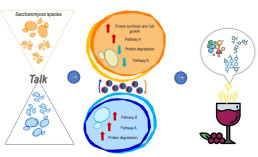
Interactions between Saccharomyces and Non-Saccharomyces yeasts: a pathway to wine aroma and quality (Image created with bioRender).
What Does This Mean for Winemaking?
The discovery that yeasts may communicate through EVs opens up exciting new possibilities for winemaking. If we understand how these vesicles work, winemakers might be able to control fermentation more precisely. Could EVs be used to speed up fermentation, create specific aromas, or prevent unwanted microbes from taking over? Future research may lead to innovative ways to fine-tune the winemaking process and create unique and high-quality wines.
As scientists continue to uncover the hidden ways yeasts communicate, one thing is clear: these tiny vesicles might hold the secret to unlocking new flavours and improving winemaking techniques.
References:
[1] Zilelidou, E. A., & Nisiotou, A. (2021). Understanding wine through yeast interactions. In Microorganisms (Vol. 9, Issue 8). MDPI AG. https://doi.org/10.3390/microorganisms9081620
[2] Mencher, A., Morales, P., Valero, E., Tronchoni, J., Patil, K. R., & Gonzalez, R. (2020). Proteomic characterization of extracellular vesicles produced by several wine yeast species. Microbial Biotechnology, 13(5), 1581–1596. https://doi.org/10.1111/1751-7915.13614
[3] Mencher, A., Morales, P., Tronchoni, J., & Gonzalez, R. (2021). Mechanisms Involved in Interspecific Communication between Wine Yeasts. Foods, 10(8), 1734. https://doi.org/10.3390/foods10081734
[4] Mejias‐Ortiz, M., Mencher, A., Morales, P., Tronchoni, J., & Gonzalez, R. (2023). Saccharomyces cerevisiae responds similarly to co‐culture or to a fraction enriched in Metschnikowia pulcherrima extracellular vesicles. Microbial Biotechnology, 16(5), 1027–1040. https://doi.org/10.1111/1751-7915.14240
[5] Planells‐Cárcel, A., Quintas, G., Pardo, J., Garcia‐Rios, E., & Guillamón, J. M. (2025). Exploring Proteomic and Metabolomic Interactions in a Yeast Consortium Designed to Enhance Bioactive Compounds in Wine Fermentations. Food Frontiers. https://doi.org/10.1002/fft2.70018