Engineering the future of winemaking: A visit to Parsec
By: Katherine Rabik
24/07/2025
In a quiet industrial park on the outskirts of Florence lies the unassuming headquarters of Parsec, a company that blends engineering with oenology and serves as an Associated Partner of Eco2Wine. Katherine Rabik, one of the Eco2Wine doctoral candidates, recently spent two weeks at Parsec, where she met with their head engineer and consulting oenologists, toured their facilities, and visited wineries using Parsec’s systems in real-world settings. What Parsec does may seem technical at first glance, but the underlying goal is simple: to give winemakers greater precision, more control, and the space to let fermentations and wine aging unfold properly.
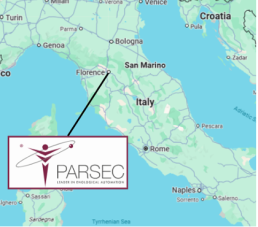
Parsec’s central headquarters are located in Florence, Italy.
From Sensors to Cellars
Parsec’s core focus is automation and process control in winemaking. They design systems that monitor and adjust fermentation conditions in real-time (temperature, gas levels, fermentation kinetics, etc.) while also building the hardware needed to apply those changes: pumps, valves, injectors, mixers, and thermal regulators.
However, Parsec’s solutions are not a one-size-fits-all approach. They work with winemakers to design tailormade systems customised to their unique needs. This approach was clearly highlighted by CEO Giuseppe Floridia: “We aren’t here to sell you things. We are here to understand your problems and help you solve them with technology”.
Support, Not Substitution
A scientific and technological approach to winemaking can sometimes put Parsec at odds with winemakers who are resistant to the new approach and changes. For older winemakers, software may be a challenge, which is why Parsec has developed an intuitive and easy to use platform.
Parsec’s team was clear that their products can never replace the expertise and skill of a winemaker, and they aren’t intended to. Instead, they can allow winemakers to have more control over the winemaking process, preventing problems before they arise.
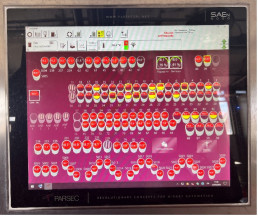
An example monitoring station set up at a winery. The winemaker can select any tank to view real time data and make adjustments as needed.
IT Manager Georgia De Cicco demonstrated the capabilities of their bespoke software that can manage all aspects of winemaking and allows winemakers to create specific recipes for each of their products. For example, automatically adjusting temperature based on sugar levels can support more efficient fermentation which is both more cost effective and uses less energy. Ultimately, the goal isn’t to replace hands-on knowledge, but to support it with tools that respond to the winemaker’s decisions. The technology is designed to support winemakers.
Real Wineries, Real Results
One of the highlights of the visit was getting out of the lab and into the vineyards. Katherine was able to join Parsec oenologist Mathieu de Basquiat and some prospective clients as they saw Parsec’s technology in action at both their own experimental winery and another producer in the Chianti Classico area. In each case, the winemakers spoke about how the technology had changed their workflow: fewer manual interventions, more consistent fermentations and controlled wine aging with no surprises in the tank. One winemaker demonstrated how they could now track fermentation progress remotely, adjusting variables with the same ease as tweaking a thermostat.
This was not flashy innovation for its own sake, but rather practical support that enables wineries to stay focused on quality. For many, this also means cutting down on unnecessary energy use, limiting additives, and getting cleaner, more expressive wines. That’s directly aligned with what Eco2Wine is aiming for: lower-input, microbiologically diverse winemaking that’s sustainable for both the planet and the producer.
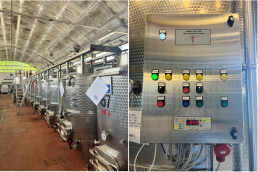
Left: Fermentation tanks at Cantina Tuscania, Parsec’s experimental winery. Right: A bespoke micro-oxygenation system installed at a winery in the Chianti Classico area.
From Tuscany to the World
Parsec recognises the importance of understanding the different cultural and economic contexts across the countries in which they operate. Oenologist Andrea Uliva, recently returned from a trip to the USA, highlighted how they frame the benefits of their technology differently depending on the country. For example, he noted that highlighting improved control over the winemaking process resonates more with European clients, while in the U.S., emphasizing cost savings, along with the advantages of automated control, tends to be more effective.
This sensitivity to context mirrors the communication challenges within the Eco2Wine project itself. With partners spread across seven countries, each with its own winemaking history, traditions, and culture, the way research is communicated and received can vary widely. Supporting dialogue between wine producers and wine scientists is not just about translating language but about tuning in to local mindsets. Whether it’s presenting microbial research to winemakers in Slovenia or engaging wine scientists in South Africa, the techniques and messaging has to adapt. Just like Parsec customises its engineering, Eco2Wine has to tailor its communication.
Collaboration Over Transactions
What sets Parsec apart, beyond their technology, is their approach. As an Associated Partner of Eco2Wine, they’re contributing time, expertise, and resources without financial compensation, simply because they believe in the value of the work. Their team thrives on collaboration with universities and research institutions, and they’re hosting several of the project’s Doctoral Candidates, opening the door to hands-on experimentation and honest dialogue between industry and science.
This spirit of open, mutual exchange is what makes them such a strong fit for a project like Eco2Wine. Like the researchers involved, they recognise that meaningful innovation can’t be copied and pasted across borders. It takes flexibility, context awareness, and a willingness to listen. Parsec’s systems may be high-tech, but their success depends on human relationships – engineers learning from winemakers, winemakers trusting scientists, and everyone involved working toward smarter, more sustainable wine.
Learn more about Parsec and their technology by visiting https://parsecsrl.net/en/