Penultimate Eco2Wine consortium meeting in Cádiz
23 October 2026
The Eco2Wine consortium gathered at the University of Cádiz (UCA) in southern Spain on 22–23 October 2026 for its third annual project meeting. With the Horizon Europe-funded doctoral network entering its final year, the meeting provided an opportunity to review achievements and plan the final phase of the research and doctoral training. As in previous years, the meeting combined two elements: a day of scientific presentations by the doctoral candidates, followed by a session in which the project’s supervisors met to review progress and discuss the project’s remaining work.
Doctoral candidates share their progress
The first day focused on the doctoral candidates, each of whom presented their research and fielded questions from the research supervisors. Several associated project partners and external experts attended the meeting online. Professor Gustavo Cordero Bueso from the host university welcomed everyone, followed by an overview of key activities and outputs from Eco2Wine Project Leader, Professor Ileana Vigentini.
The candidates’ talks highlighted the scope, diversity and complexity of the research undertaken by the 10 participating doctoral candidates.
On the microbial biodiversity front, Aubrey Lee (University of Perugia) presented strategies and technologies to preserve yeast strain and consortia biodiversity in oenology, while Lucija Batistić (University of Ljubljana) shared mapping and characterisation of grape-associated microbial communities across Europe and South Africa.
A second set of talks explored how yeasts interact during winemaking. Jeanne Laforge (Stellenbosch University) presented her modelling of wine yeast fermentation ecosystems; Maria Vazquez Fernandez (University of Burgundy) demonstrated how metabolomics can be used to study microbial interactions in wine; and Virgile Rose (CSIC) discussed his investigation of interactions among yeast species used as starter cultures in winemaking.
Two presentations focused on the social sciences. Katherine Rabik (Stellenbosch University) presented her work on bridging the gap between microbiomics and winemaking practices, while Capucine Dentraygues (Hochschule Geisenheim University) shared updates on her analysis of consumer preferences for natural and biotechnological wines.
In the afternoon, the focus shifted to vineyard management and biocontrol strategies for addressing biotic and abiotic stresses. Elena Palencia Mulero (University of Milan) and Jose Luis Padilla (University of Cádiz) presented their research on using microorganisms as bioprotective agents in viticulture, examining the molecular mechanisms underpinning microbial interactions and their potential to reduce chemical inputs in wine and table grape production. Shamin Bhandari (University of Milan) presented her research on microbial consortia that can enhance grapevine tolerance to drought stress, highlighting their potential to support more sustainable and resilient viticulture.
Short discussions, led by the work package chairpersons, followed each group of talks. They gave doctoral candidates the opportunity to receive feedback and to connect their work with other parts of the project.
Ciencia con Vino y Tapas: science meets the public
On the evening of 22 October, the team opened its doors to the public for “Ciencia con Vino y Tapas”, an Eco2Wine Science Café at the University of Cádiz. The relaxed, bilingual (English and Spanish) event invited attendees to enjoy wine, tapas and conversation with young researchers working on the future of sustainable winemaking.
Supervisory Board looks ahead to the final year
On 23 October, the Supervisory Board, comprising the ten project supervisors and some support staff, met to review project management, reporting and finances, doctoral candidate secondments, and the status of deliverables and milestones. The discussions also covered the doctoral candidates’ career development plans, the integration of scientific methods and results across the project, remaining training activities and network-wide events, and communication and dissemination activities for the final project year. The board closed the meeting by agreeing on priorities, responsibilities and key deadlines for the months ahead, and looked forward to the next meeting, to be hosted at UMIL in April 2027, with a final online Eco2Wine conference planned for November 2027.
Looking ahead
The Cádiz meeting showed how far the doctoral candidates have progressed since the project began and how closely the research strands now converge. As Eco2Wine enters its final year, the consortium remains committed to advancing sustainable, microbiome-informed approaches to viticulture and winemaking while training a new generation of researchers to work at the interface of science, industry and society.
The Eco2Wine Project is funded by the European Union under Grant Agreement 101119480.
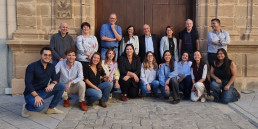
The Eco2Wine supervisors and doctoral candidates at the University of Cádiz during the third annual project meeting, 22–23 October 2026.