
More than just an aroma: the hidden chemistry yeasts use to protect the vineyard
By: José Luis Padilla Agudelo (DC8)
23/11/2026
When you bring a glass of wine to your nose, you might notice hints of fruit, flowers or spices. Behind many of these familiar aromas are tiny molecules produced during fermentation, a process in which yeasts play an essential role. But here is something you might not expect: some of these molecules, or chemically related substances, can do much more than shape a wine’s aroma. They can also help yeasts defend themselves against their competitors.
Yeasts do not simply appear when grapes arrive at the winery. Many already live naturally in the vineyard, on grape skins, leaves and other parts of the vine. Some can even live inside plant tissues without causing disease. The first are known as epiphytes, while the second are called endophytes. Together, they form part of a diverse microscopic community where competition for space and nutrients is constant. And some yeasts have developed a remarkable strategy: releasing molecules that can travel through the air and make it harder for other microorganisms to grow.
The enemy: grey mould
To understand why this ability matters, we first need to meet the opponent: Botrytis cinerea, the fungus responsible for grey mould (also known as botrytis bunch rot in grapes). This is one of the most troublesome pathogens (or disease-causing microorganisms) affecting many crops. In vineyards, it can cause major losses in both grape yield and quality, especially when damp conditions favour its growth [1]. Traditionally, growers have controlled it through preventive agricultural practices and chemical fungicides. Although these treatments can be effective, their use raises environmental concerns, and resistant populations can make them less reliable. That is why scientists are exploring more sustainable alternatives, including a resource that nature already provides [1–3].
A chemical battle without contact
Imagine two microorganisms a short distance apart. They cannot touch, yet one begins to release invisible molecules that spread through the air. When these substances reach the other microorganism, they may slow its growth or disrupt cellular functions. This phenomenon is known as volatile-mediated antibiosis. It involves volatile organic compounds (VOCs), small molecules that can evaporate and travel through the air, allowing one microorganism to inhibit another without direct contact. Unlike competition for nutrients or space, this mechanism does not require the organisms to touch each other or involve the plant’s own defence responses [2, 5].
How can scientists test whether these invisible molecules are responsible?
Scientists can grow yeasts and fungi in separate compartments that share the same air but not the same culture medium. They also use a control in which the fungus grows under otherwise identical conditions, but without the yeast. If fungal growth is reduced only when yeast is present, an airborne effect is a plausible explanation. The separate compartments rule out direct contact and competition for nutrients in the same medium, while a plant-free experiment excludes the plant’s own defence response. Even so, changes in the shared atmosphere could also affect the fungus, so further controls and tests with individual compounds are needed to confirm the role of VOCs [2, 5].
But what does it actually mean when we say that fungal growth is inhibited? It does not necessarily mean that the fungus has been killed. Some compounds may simply slow or stop its growth, producing a fungistatic effect, while others may kill it, producing a fungicidal effect. Researchers can investigate this difference by checking whether the fungus starts growing again once exposure ends. Yet understanding how the fungus responds is only part of the story. Another question remains: which molecules drive this invisible defence?
Decoding the yeasts’ chemical arsenal
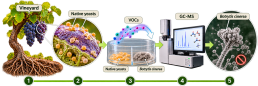
Thanks to advances in analytical techniques, scientists can now identify many of the substances released by microorganisms. One of the most widely used tools is gas chromatography–mass spectrometry (GC–MS). The name may sound complicated, but the principle is quite simple. First, researchers collect the compounds present in the air around the yeasts, for example using a tiny fibre that traps volatile molecules. The instrument then separates the compounds and analyses their chemical characteristics, a bit like identifying every ingredient in a perfume from its molecular fingerprint (Figure 1). This lets scientists identify alcohols, esters, acids, and other substances that make up a yeast’s volatile profile. However, detecting a compound does not necessarily mean that it has antifungal activity. To find out, researchers need additional experiments to test its effects on the pathogen.
Figure 1. Schematic overview of the potential antifungal activity of volatile organic compounds (VOCs) produced by native vineyard yeasts. In separated-compartment assays, yeasts and B. cinerea share air but not culture medium, allowing researchers to test for growth inhibition without direct contact. GC–MS helps identify the released compounds, while additional bioassays are needed to determine which VOCs are responsible. Illustration created using OpenAI’s image generation tool.
So, what are these compounds?
Volatile organic compounds (VOCs) are generally small molecules with relatively high vapour pressure, allowing them to evaporate easily and disperse through the air. Their physical and chemical properties vary by compound, influencing how they move through the environment and interact with other microorganisms [4]. The main volatiles released by biocontrol yeasts include alcohols (ethanol, 3-methyl-1-butanol and 2-phenylethanol) and esters (ethyl acetate and isoamyl acetate) [5], along with short-chain fatty acids [6]. Many of these compounds may sound unfamiliar, but their aromas are not: they help give wine its distinctive bouquet.
- 2-Phenylethanol: A floral aroma reminiscent of roses. It is one of the most abundant compounds found among yeast volatiles [7–8]. For example, researchers detected it in an endophytic yeast that can inhibit the growth of Botrytis [7].
- 2-Phenylethyl acetate: Floral and fruity notes. In Pichia yeasts isolated from wild vines, this compound showed particularly strong activity, completely inhibiting the growth and spore germination of B. cinerea at a tested concentration under laboratory conditions [8].
- Isoamyl acetate and 3-methyl-1-butanol: Banana and malty notes, respectively. Both were among the most abundant volatile compounds produced by those same Pichia yeasts [8].
- Ethyl acetate: One of the main volatile compounds produced by Saccharomyces cerevisiae, the familiar wine yeast, whose volatiles also slowed the growth of Botrytis in laboratory experiments [9].
Why is this so promising?
Rather than relying exclusively on fungicides, this approach aims to make use of the natural relationships between organisms to help keep pathogens under control. Yeasts that produce volatile compounds are especially interesting because they can act at a distance. This opens the door to new ways of protecting vineyards, using either living microorganisms or the substances they produce.
But what are the challenges?
There is a catch, though. The types and amounts of VOCs produced can vary from one yeast strain to another and with temperature, nutrient availability and other growing conditions. A compound that inhibits a pathogen at one concentration could also harm plant tissues at another, so possible phytotoxicity must be assessed. And, a sealed Petri dish is very different from an open vineyard: airflow, weather and interactions with other organisms can change how VOCs spread and behave. Much of the evidence so far comes from in vitro experiments, and encouraging laboratory results do not guarantee the same protection in the field. Trials on living grapevines and under vineyard conditions are therefore essential before VOC-based treatments can be used reliably [4, 5].
Despite these challenges, the potential of yeast-produced VOCs offers an exciting direction for sustainable viticulture. Understanding which native yeasts produce antifungal compounds, how these molecules interact with pathogens, and whether their effects can be maintained under vineyard conditions could help develop new biological control strategies. This perspective is also closely connected to the broader goals of the Eco2Wine project, which seeks to better understand and harness beneficial microbial interactions for more sustainable grape and wine production.
References
[1] Lemos Junior, W. J. F., Bovo, B., Nadai, C., Crosato, G., Carlot, M., Favaron, F., Giacomini, A., & Corich, V. (2016). Biocontrol ability and action mechanism of Starmerella bacillaris (synonym Candida zemplinina) isolated from wine musts against grey mold disease agent Botrytis cinerea on grape and their effects on alcoholic fermentation. Frontiers in Microbiology, 7, 1249. https://doi.org/10.3389/fmicb.2016.01249
[2] Martelanc, M., Žežlina, L., Radovanović Vukajlović, T., Sternad Lemut, M., & Butinar, L. (2024). Yeast-produced volatiles in grape based system model acting as antifungal bioagents against phytopathogen Botrytis cinerea. OENO Macrowine 2023, IVES Conference Series. https://ives-openscience.eu/40739
[3] Esteves, M., Lage, P., Sousa, J., Centeno, F., de Fátima Teixeira, M., Tenreiro, R., & Mendes-Ferreira, A. (2023). Biocontrol potential of wine yeasts against four grape phytopathogenic fungi disclosed by time-course monitoring of inhibitory activities. Frontiers in Microbiology, 14, 1146065. https://doi.org/10.3389/fmicb.2023.1146065
[4] Belt, K., Dow, L., Gallart, M., & Thatcher, L. F. (2026). Harnessing microbial volatile organic compounds for crop protection: Scientific discovery, bridging ecological function and on-farm application. Microbial Biotechnology, 19(2), e70313. https://doi.org/10.1111/1751-7915.70313
[5] Zhao, X., Zhou, J., Tian, R., & Liu, Y. (2022). Microbial volatile organic compounds: Antifungal mechanisms, applications, and challenges. Frontiers in Microbiology, 13, 922450. https://doi.org/10.3389/fmicb.2022.922450
[6] Sabaghian, S., Braschi, G., Vannini, L., Patrignani, F., Samsulrizal, N. H., & Lanciotti, R. (2021). Isolation and identification of wild yeast from Malaysian grapevine and evaluation of their potential antimicrobial activity against grapevine fungal pathogens. Microorganisms, 9(12), 2582. https://doi.org/10.3390/microorganisms9122582
[7] Vidal, A., Castro, P., Navarro, F., Parada, R., Mendoza, L., & Cotoras, M. (2024). Effect of volatile compounds emitted by an endophytic yeast isolated from the endemic plant Echinopsis chiloensis against Botrytis cinerea. Horticulturae, 10(9), 1005. https://doi.org/10.3390/horticulturae10091005
[8] Hernández-Fernández, M., Izquierdo-Bueno, I., Cordero Bueso, G., & Cantoral, J. M. (2025). Key VOCs from Pichia kluyveri and Pichia kudriavzevii: 2-phenylethyl acetate and 2-phenylethanol against Botrytis cinerea. LWT, 227, 118015. https://doi.org/10.1016/J.LWT.2025.118015
[9] Meng, Y., Wang, J., Xu, H., Yu, Y., & Liang, Y. (2025). A novel plate compartment-confrontation method discovered that volatile organic compounds produced by Saccharomyces cerevisiae inhibit Botrytis cinerea and Fusarium graminearum. Journal of Fungi, 11(6), 418. https://doi.org/10.3390/jof11060418