Fermenting Ideas: My Life Between Yeast and Wine
By Maria Vazquez Fernandez, Eco2Wine doctoral candidate
29/08/2025
One year ago, when I started my PhD, my life was turned upside down. I have been curious about living and working abroad since I was a child. The stars aligned when I saw an opportunity with the international Eco2Wine project – one that completely transformed my life.
I’m now working on something that truly inspires me, and doing it in France, specifically in a beautiful city called Dijon. This new journey has been all about learning, adapting, and embracing the challenge of starting a life in a different country.
My PhD project
This new chapter of my life revolves around microbiology and the fascinating world of yeast in winemaking. My PhD project focuses on characterizing the nature of interactions among microorganisms in a natural environment, such as those involved in alcoholic fermentation during winemaking. I am using a metabolomic approach to uncover the hidden language these microorganisms use to communicate, collaborate and compete.
What exactly does “metabolomic approach” mean? Yeasts are incredibly busy, tiny, single-cell organisms that constantly produce hundreds, even thousands, of small molecules called metabolites. These molecules serve many purposes, from signaling and defense to contributing to the flavour and aroma of wine. By analysing the metabolites they produce, we can gain deep insights into what’s happening inside the cells and how they interact with each other. To do metabolomics, we must separate all the metabolites present in the wine and then identify them using high-performance liquid chromatography (HPLC) coupled with mass spectrometry (MS). Then, statistical analysis helps us interpret all of this complex data to better understand yeast metabolism and its impact on wine quality.
How is a day in the lab working in wine research?
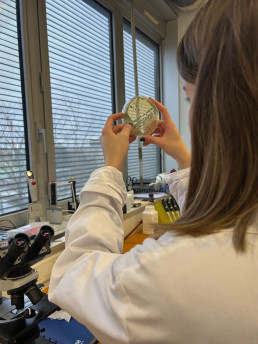
Every day in the lab brings a new challenge. Scientists don’t just wear lab coats and swirl flasks; we juggle protocols, equipment, and unexpected surprises to get our experiments to work as planned – or, at least, close to it!
I’m studying how different yeast species interact when grown together, so with these experiments I am recreating a mini version of the winemaking process. For that, I rely on several high-tech machines. A first (and occasionally panic-inducing) challenge is learning how to use them.
One is the flow cytometer, a complex machine that can count and measure cells and even tell us whether they’re alive or dead. This is crucial when studying mixed yeast cultures, because we need to track how each species evolves during alcoholic fermentation.
Once you’ve figured out how to use the equipment (and made peace with its quirks), it’s time for round two: dealing with the microorganisms. That’s when the real party begins.
Yeasts have a mind of their own. Sometimes they do the opposite of what you expect. Then, doubts flood my mind: Did I inoculate correctly? Is the medium right? Is there contamination? What just happened?!
The beauty of science
The beauty of science is that the unexpected is not always a setback. It can even be more exciting than the predicted results. These “surprises” can lead to deeper understanding, new questions, and sometimes even better answers than the ones you were seeking. In the lab, unpredictability isn’t the enemy; it’s part of the journey.
Working with yeast in the context of winemaking may sound niche, but it’s a window into the invisible world that shapes the flavours, aromas, and success of fermentation. Through a metabolomic lens, I explore how these tiny cells interact, evolve, and sometimes surprise us, because in science, things rarely go exactly as planned. That’s the magic of it.
Lab work brings several new things my way – technical hurdles, unexpected results, and small insights… It’s frustrating, messy, and chaotic, but also thrilling, creative, and deeply rewarding.
At the end of the day, I’m not just studying yeast. I’m learning how to ask better questions, listen to what the data tells me, and how to keep moving forward, even when the experiment doesn’t go as expected. That’s what science is all about.