
Metagenomics and MVDA Training – Stellenbosch University
Blog
October 9 – 11, 2024
In today’s research landscape, it is essential for PhD students to go beyond mastering not only their specific research topics but also a broad array of interdisciplinary skills. Recognizing this need, a specialized training course was recently held at Stellenbosch University, offering an integrated approach to three critical areas: science communication, metagenomics, and statistical analysis. This comprehensive course aimed to equip young researchers with the tools to effectively communicate their findings, analyze complex biological data and apply rigorous statistical methods.
Following the science communication course, the Eco2Wine DCs took part in an intensive three-day training on bioinformatics and metagenomics. This was completed at the Biomedical Research Institute (BMRI) and the Department of Viticulture and Oenology at Stellenbosch University. Dr Kristien Nel Van Zyl, a computational biologist at the African Microbiome Institute, led the training on metagenomics and Dr Mpho Mafata, a post-doctoral fellow with the database team at the Centre for Research on Evaluation, Science and Technology (CREST), led the training on multivariate statistical analysis.

Fig 1. Dr Mpho Mafata introducing DCs to the application of multivariate statistical analysis in wine science.
The training offered a comprehensive dive into the world of bioinformatics, focusing on metagenomics, statistical analyses, and graphical data representation using the R software environment. The goal was to provide the team with practical knowledge and techniques for unravelling the microbial diversity present in vineyards and how it affects wine quality. Through lectures and hands-on sessions, participants learned how to process metagenomic data, analyze the composition of microbial communities, and interpret the results to gain insights into how these microorganisms influence grape quality and wine flavour.
The DCs were also treated to a tour of the BMRI labs and fully automated biorepository (BiOS), the first in the Southern Hemisphere, led by the Unit Manager Rubeshan Nayager.
Fig 2. Learning more about the functionality of the state-of-the-art, fully automated biorepository which is used to store millions of samples for a wide variety research projects.
Metagenomics is an essential tool in the Eco2Wine project, as it supports the investigation of the complex interactions between various microorganisms found in vineyard soils, on grape surfaces, and during the fermentation process. By understanding which microbes are beneficial or detrimental to wine production, more informed decisions about vineyard management and fermentation strategies can be made. This deeper understanding will eventually lead to better control of the winemaking process, resulting in wines with enhanced aromas, flavours, and overall quality. Moreover, this training emphasized the importance of statistical analysis in bioinformatics, offering insights into handling large datasets while ensuring data integrity and visualizing findings effectively. The sessions on R programming were particularly valuable, giving participants the skills to produce high-quality graphs and visual outputs that will be used in their ongoing research.
The week concluded with the DCs visiting the experimental research vineyards of Stellenbosch University, led by Prof Florian Bauer. This experience allowed them to see viticulture research in action while enjoying the beautiful natural surroundings of Stellenbosch. It was a fitting and memorable way to wrap up their time in South Africa, before many of the DCs returned to their respective universities across Europe to continue their own research.

Fig 3. Enjoying a beautiful day exploring the Stellenbosch University experimental vineyards.
References
1. Stenberg JA, Sundh I, Becher PG, et al. When is it biological control? A framework of definitions, mechanisms, and classifications. J Pest Sci (2004). 2021;94(3):665-676. doi:10.1007/s10340-021-01354-7
2. Zhang H, Godana EA, Sui Y, Yang Q, Zhang X, Zhao L. Biological control as an alternative to synthetic fungicides for the management of grey and blue mould diseases of table grapes: a review. Crit Rev Microbiol. 2020;46(4):450-462. doi:10.1080/1040841X.2020.1794793
3. United Nations. The Sustainable Development Goals.; 2015.
4. Cordero-Bueso G, Mangieri N, Maghradze D, et al. Wild grape-associated yeasts as promising biocontrol agents against Vitis vinifera fungal pathogens. Front Microbiol. 2017;8(NOV). doi:10.3389/fmicb.2017.02025
5. Palmieri D, Ianiri G, Del Grosso C, et al. Advances and Perspectives in the Use of Biocontrol Agents against Fungal Plant Diseases. Horticulturae. 2022;8(7). doi:10.3390/horticulturae8070577
6. Lahlali R, Ezrari S, Radouane N, et al. Biological Control of Plant Pathogens: A Global Perspective. Microorganisms. 2022;10(3). doi:10.3390/microorganisms10030596
7. Ayaz M, Li CH, Ali Q, et al. Bacterial and Fungal Biocontrol Agents for Plant Disease Protection: Journey from Lab to Field, Current Status, Challenges, and Global Perspectives. Molecules. 2023;28(18). doi:10.3390/molecules28186735
About the authors:
José L. Padilla Agudelo, with a Master’s in Microbiology, and Elena Palencia Mulero, with a Master’s in Microbiology & Health, are both Doctoral Candidates in the prestigious Marie Skłodowska-Curie Action, part of the Horizon Europe Doctoral Network. Their work is funded by the European Union under Grant Agreement 101119480, within the project: “NATURAL MICROBIAL INTERACTIONS IN WINEMAKING-ASSOCIATED ECOSYSTEMS AS A TOOL TO FOSTER WINE INNOVATION (Eco2Wine).”
José is part of Prof. Gustavo A. Cordero Bueso’s team at the University of Cádiz in Spain, while Elena works with Prof. Ileana Vigentini at the University of Milan in Italy, who also coordinates the Eco2Wine Project. Together, they are diving into the “Grapevine and Grape Biocontrol” Work Package, aiming to uncover and explain the molecular mechanisms behind new biocontrol agents that combat the harmful fungus Botrytis cinerea, a major threat to vineyards.
Main Contacts:
elena.palencia@unimi.it
joseluis.padillaagudelo@alum.uca.es
gustavo.cordero@uca.es
ileana.vigentini@unimi.it


Eco2Wine at the International Congress on Yeast 2024
Blog
October 15, 2024
From 29th September to 3rd October 2024, the 16th International Congress on Yeasts (ICY) took place in Cape Town at the International Convention Centre. A total of 274 participants from 41 countries attended the 5-day congress. The objective of the congress was to provide an opportunity for academics, researchers, industry scientists and students to come together and share their latest research developments and expand their networks. The Eco2Wine Doctoral Candidates (DCs) attended the congress, marking the first time all 10 DCs met in person. Six of the Eco2Wine DCs presented their projects in the form of posters, which was a great opportunity to increase the visibility of their work and spark discussion within the scientific community.
Fig 1. The six Eco2Wine doctoral candidates who presented posters at the ICY 2024 Congress were, from left to right: José Luis Padilla, Elena Palencia Mulero, María Vázquez Fernández, Andrea Rukavina, Jeanne Laforge, and Aubrey Lee.
On the first day, participants were welcomed with a performance by South African singer-songwriter Tracey Carter. Professor Florian Bauer, congress chair and Eco2Wine Principal Investigator at Stellenbosch University, officially opened the congress. Over the course of five days, multiple themes on yeast were explored and divided into breakout sessions to allow participants to attend and interact with individuals who aligned with their research interests. Professor Ileana Vigentini, Eco2Wine Project Leader, delivered a keynote presentation on “Distinctive genetic landscape of Georgian wine yeasts: insights from molecular characterization and comparative genomics”.
“The congress was a perfect blend of professional duty and delightful escapade; I believe all of us learnt something new while having fun”, said DC Aubrey Lee. “It was great to finally meet all the DCs face-to-face after all the online interactions we had for the past months.” On the fourth day, the ICY committee arranged a series of excursions for the participants to experience Cape Town, along with a formal dinner at Simon’s Restaurant.
On the last day of the conferences, attendees were treated to a session on communicating the science of yeasts. This was the first year a session focused on science communication was included at the ICY conferences, and it reflects the increasing recognition of the field’s importance.
The session began with Karien O’Kennedy (South Africa Wine, Eco2Wine Partner) discussing knowledge transfer within the South African wine industry. Drawing from her own professional and academic experience, Karien highlighted winemakers’ information-seeking behaviours and outlined some perceived benefits and constraints to engaging with academia and wine science research.
Marina Joubert (Stellenbosch University, Eco2Wine Principal Investigator) discussed the development of science communication as an academic field. She outlined several reasons why scientists engage with various public groups to communicate their research, including educational, economic, strategic and moral motives. Marina also emphasized the importance of trust to successful science communication and highlighted the imperative to engage diverse audiences to ensure science is just, equitable and inclusive.
Next, the audience heard from Anna Dimitriu, a renowned artist who collaborates with scientists to create artworks using biological materials or processes. Often working hands-on in the lab, Anna detailed some of her current and previous exhibitions that involved yeasts, including “Wood Spirit – Amber Acid”, which was on display at the ICY. This sculptural necklace showcases Pichia pastoris, a yeast that has been modified to feed on methanol and assist in producing sustainable nylon fabrics.
Finally, contemporary artist Alex May shared his development of “algorithmic photography”, a technique that allows for the representation of a series of discrete moments in time in a single image. He has used this technique to document scientists in the lab, capturing aspects of the scientific process that most publics don’t get to see firsthand.
The session concluded with the speakers forming a panel and answering questions from the audience. These discussions spotlighted the importance of engaging public audiences in the communication process, accurately capturing scientific uncertainties in communication and using creative techniques to draw audiences into the beauty of science.
The 16th ICY was a productive experience for the Eco2Wine DCs, as it allowed them to share their projects and interact with other researchers while having a wonderful experience in Cape Town. “This marks the first visit to South Africa for most of us. The congress definitely helped create an unforgettable memory of this rainbow nation. We are truly grateful to the European Horizon for funding our projects and the opportunity to attend this congress for the international experience and exposure”, added DC María Vázquez Fernández.
References
1. Stenberg JA, Sundh I, Becher PG, et al. When is it biological control? A framework of definitions, mechanisms, and classifications. J Pest Sci (2004). 2021;94(3):665-676. doi:10.1007/s10340-021-01354-7
2. Zhang H, Godana EA, Sui Y, Yang Q, Zhang X, Zhao L. Biological control as an alternative to synthetic fungicides for the management of grey and blue mould diseases of table grapes: a review. Crit Rev Microbiol. 2020;46(4):450-462. doi:10.1080/1040841X.2020.1794793
3. United Nations. The Sustainable Development Goals.; 2015.
4. Cordero-Bueso G, Mangieri N, Maghradze D, et al. Wild grape-associated yeasts as promising biocontrol agents against Vitis vinifera fungal pathogens. Front Microbiol. 2017;8(NOV). doi:10.3389/fmicb.2017.02025
5. Palmieri D, Ianiri G, Del Grosso C, et al. Advances and Perspectives in the Use of Biocontrol Agents against Fungal Plant Diseases. Horticulturae. 2022;8(7). doi:10.3390/horticulturae8070577
6. Lahlali R, Ezrari S, Radouane N, et al. Biological Control of Plant Pathogens: A Global Perspective. Microorganisms. 2022;10(3). doi:10.3390/microorganisms10030596
7. Ayaz M, Li CH, Ali Q, et al. Bacterial and Fungal Biocontrol Agents for Plant Disease Protection: Journey from Lab to Field, Current Status, Challenges, and Global Perspectives. Molecules. 2023;28(18). doi:10.3390/molecules28186735
About the authors:
José L. Padilla Agudelo, with a Master’s in Microbiology, and Elena Palencia Mulero, with a Master’s in Microbiology & Health, are both Doctoral Candidates in the prestigious Marie Skłodowska-Curie Action, part of the Horizon Europe Doctoral Network. Their work is funded by the European Union under Grant Agreement 101119480, within the project: “NATURAL MICROBIAL INTERACTIONS IN WINEMAKING-ASSOCIATED ECOSYSTEMS AS A TOOL TO FOSTER WINE INNOVATION (Eco2Wine).”
José is part of Prof. Gustavo A. Cordero Bueso’s team at the University of Cádiz in Spain, while Elena works with Prof. Ileana Vigentini at the University of Milan in Italy, who also coordinates the Eco2Wine Project. Together, they are diving into the “Grapevine and Grape Biocontrol” Work Package, aiming to uncover and explain the molecular mechanisms behind new biocontrol agents that combat the harmful fungus Botrytis cinerea, a major threat to vineyards.
Main Contacts:
elena.palencia@unimi.it
joseluis.padillaagudelo@alum.uca.es
gustavo.cordero@uca.es
ileana.vigentini@unimi.it
Science Communication Takes the Stage at International Yeast Congress
Blog
October 15, 2024
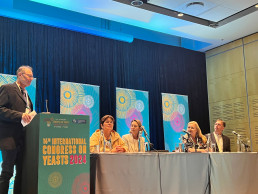
For the first time in its history, the 16th International Congress on Yeasts included a dedicated session on science communication — coordinated by Prof Marina Joubert of Stellenbosch University’s CREST.
The 16th International Congress on Yeasts (ICY2024) brought together leading researchers, industry scientists, and students from around the world at the Cape Town International Convention Centre from 29 September to 3 October 2024. The congress — held every four years under the auspices of the International Commission on Yeasts — is the flagship gathering for the global yeast science community, covering yeast biodiversity, biotechnology, and pathogenic yeast research.
This year’s event marked a notable first: a dedicated session on science communication and public engagement, coordinated by Prof Marina Joubert from the Centre for Research on Evaluation, Science and Technology (CREST) at Stellenbosch University. The session, titled ‘Yeasts and science engagement: Creative strategies for communication and knowledge sharing’, explored how scientists working in specialist fields like yeast research can communicate more effectively with diverse public audiences.
In her talk, Prof Joubert provided an overview of current trends and best practice in science communication, drawing on the growing body of evidence from the ‘science of science communication’. A central theme was the shift away from the outdated ‘deficit model’ — the assumption that public scepticism about science stems simply from a lack of information — towards more dialogic, trust-based approaches that genuinely engage communities rather than merely informing them.
The session also highlighted the role of storytelling, the importance of justice, equity, diversity and inclusivity (JEDI) in reaching broader audiences, and the emerging framing of science engagement as a human right under international law.
The science communication session was complemented by a striking science-art collaboration: two British artists who had worked alongside yeast researchers in the laboratory of Prof Diethard Mattanovich at BOKU University in Vienna shared their visual interpretations of the scientific process and of yeast research specifically — an example of the creative cross-disciplinary approaches that can bring science to new audiences.
ICY2024 was the first time this premier international congress was held on African soil, making the Cape Town gathering a landmark event for the local scientific community and an opportunity to strengthen ties between African and international yeast researchers. The next congress is scheduled for Madison, Wisconsin, USA, in 2028.

Training Event “Omics Technologies Applied to Research in Vitiviniculture”: bridging the gap from soil to wine
Blog
25 July 2024
The first week-long training event for doctoral students participating in the Eco2Wine project was held in July 2024. Titled “Omics Technologies Applied to Research in Vitiviniculture,” the event focused on the application of high-throughput sequencing techniques in viticulture and winemaking.
The event was held in Logroño, the capital of La Rioja, one of Spain’s most important viticulture regions. This small city is home to the Institute of Vine and Wine Sciences (ICVV-CSIC), one of the Eco2Wine beneficiaries, and the Fundación Rioja Salud, a consortium partner. The La Rioja Biomedical Research Centre’s facilities hosted the students and instructors during the theoretical-practical classes.
The training programme introduced the students to high-throughput sequencing and its vast applications in agriculture and biotechnology. It emphasised topics like de novo genomic sequencing, resequencing, transcriptomic, and metataxonomic and metagenomic analysis. Theoretical classes, with examples applied to viticulture and winemaking, were interspersed with hands-on training and an introduction to using Linux systems for bioinformatic computation.
This course in Logroño was the first opportunity for the Eco2Wine doctoral candidates to meet in person and to interact with some members of the Eco2Wine consortium. Dr Ileana Vigentini, Eco2Wine project coordinator, travelled to Logroño to give the students an overview of the project. Dr Ramón González, CSIC Research Professor at ICVV, and Dr Gustavo Cordero, Research Professor at the University of Cádiz, presented the career development and training platforms to the students. The Eco2Wine communication support team joined an online session to discuss their plans and attend the students’ presentations about their PhD projects.
However, one cannot visit La Rioja without experiencing the blend of tradition and modernity that comes together in the production of some of the most renowned wines in Spain. A technical visit was organised at the Torres Family’s winery, “La Carbonera”, an associated partner of the Eco2Wine consortium. Students were acquainted with the origins and typicity of unique wines in the Rioja Alavesa region. They learned about the extent of the vineyards, their locations and uniqueness, and the innovative processes to achieve singular wines: Las Pisadas and Malpastor. Afterwards, the group travelled to Haro, the wine capital of Rioja, to visit Bodegas Manzanos, a winery carved into the earth. Here, the students received training on the most traditional production processes of the region. Finally, they visited the laboratories, research facilities and the experimental winery of the ICVV, guided by Dr González and his colleague, Pablo Carbonell, who explained the main lines of innovation in viticultural research in the region.
“We hope that this course was a moment of learning and meeting for these young scientists on their way to achieve their doctoral qualifications and that they enjoyed visiting this region steeped in the tradition of winemaking, but also in innovation and modernity,” said Dr María de Toro Hernando, Manager of the Genomics & Bioinformatics Core Facility at the Fundación Rioja Salud and a key organiser of the event. “Cutting-edge research will be key to next-generation sequencing techniques that will open the door to the genetic and genomic study of the viticultural ecosystem, from the soil to the wine.”
Visit of Eco2Wine doctoral candidates (DCs) to the Logroño wine-making region during July 2024. In the back (from left to right): Shamin Bhandari (Eco2Wine DC4); Miguel Mejías (instructor; ICVV-CSIC); Pilar Morales (ICVV-CSIC); Virgile Rose (Eco2Wine DC7); José Padilla (Eco2Wine DC8); María Vázquez (Eco2Wine DC2); Elena Palencia (Eco2Wine DC1); Jeanne Laforge (Eco2Wine DC9); Aubrey Lee (Eco2Wine DC5); Ana Martín (ICVV-CSIC); Ana Perea (ICVV-CSIC); Capucine Dentraygues (Eco2Wine DC3); Ramón González (ICVV-CSIC); and Pablo Carbonell (instructor; ICVV-CSIC). In the front (from left to right): María de Toro (course coordinator and instructor; Fundación Rioja Salud); Ileana Vigentini (Eco2Wine project coordinator; University of Milan); Andrea Rukavina (Eco2Wine DC6); and Julio Carreter (oenologist from La Carbonera winery).
About the authors:
José L. Padilla Agudelo, with a Master’s in Microbiology, and Elena Palencia Mulero, with a Master’s in Microbiology & Health, are both Doctoral Candidates in the prestigious Marie Skłodowska-Curie Action, part of the Horizon Europe Doctoral Network. Their work is funded by the European Union under Grant Agreement 101119480, within the project: “NATURAL MICROBIAL INTERACTIONS IN WINEMAKING-ASSOCIATED ECOSYSTEMS AS A TOOL TO FOSTER WINE INNOVATION (Eco2Wine).”
José is part of Prof. Gustavo A. Cordero Bueso’s team at the University of Cádiz in Spain, while Elena works with Prof. Ileana Vigentini at the University of Milan in Italy, who also coordinates the Eco2Wine Project. Together, they are diving into the “Grapevine and Grape Biocontrol” Work Package, aiming to uncover and explain the molecular mechanisms behind new biocontrol agents that combat the harmful fungus Botrytis cinerea, a major threat to vineyards.
Main Contacts:
elena.palencia@unimi.it
joseluis.padillaagudelo@alum.uca.es
gustavo.cordero@uca.es
ileana.vigentini@unimi.it