
The “wine code”: Will wineries soon be able to predict fermentation like the weather forecasts?
By: Lucija Batistić (DC11)
24/06/2026
Wine fermentation may look like a familiar process, but it is never entirely predictable. It can develop smoothly, or it can suddenly slow down, change direction, and put wine quality at risk. By the time the warning signs are clear, the best moment for intervention may already have passed.
Now imagine if part of that uncertainty could be avoided. What if the grapes themselves could offer an early clue, showing whether fermentation is likely to remain stable or whether there is a higher risk of spoilage?
Such a scenario may sound futuristic today, but the tools are beginning to catch up with the idea. Just as meteorologists use large amounts of data to predict whether a storm might develop, future winemaking could use data available in the vineyard to anticipate how the wine production process may unfold even before the grapes are harvested.
The invisible architecture of flavour
Before fermentation begins, grapes already carry microbial communities from the vineyard into the cellar. Once grapes are crushed, these microorganisms enter the must (the fresh grape juice that will ferment into wine), and some of them can become active. Yeasts drive alcoholic fermentation, converting sugars into alcohol, while certain bacteria can contribute to malolactic fermentation, a process that transforms sharper acids into softer ones. Together, their complex interactions can influence aroma development, stability, and the final quality of wine. This is why spontaneous fermentations driven by native microflora are mostly valued, especially when producers aim to preserve the authentic character of wine.1
However, the same microbial activity can also have an undesirable side. Certain microorganisms can increase the risk of stuck fermentation, the development of unwanted aromas, or visible defects such as cloudiness, sediment and surface film.2 Relying on natural microflora therefore also requires caution. The challenge is to preserve microbial contribution to complexity without losing control over the process.
This is the difficult part: the same microbial life that can make a wine more distinctive can also push it toward spoilage. Microorganisms are not simply good or bad. Their effect depends on which species are present, when they become active, and under what fermentation conditions they develop.
Seeing the uncultivable
Microbiological monitoring of must and wine relied for decades on cultivation methods, which involve isolating and growing microorganisms in the laboratory. Yet many microorganisms do not grow easily under laboratory conditions.3 Traditional (cultivation-based) analyses therefore provide only a fragment of the picture, missing many microorganisms that may still be viable, active, and relevant for fermentation.
This limitation has changed the way we look at microbial life in wine. Instead of focusing only on what can be cultivated, contemporary molecular methods can detect microorganisms directly, by reading their genetic information. In the Eco2Wine project, we focus on metagenomic analysis, which enables the direct reading of genetic code from grapes, soil, must, or fermenting wine, capturing the DNA of all organisms present at once and allowing their identification. Beyond revealing who is present, metagenomic analysis can provide a broader picture: how the microbial community changes during different stages of processing and what potential roles individual microbial groups may play within that community and across the winemaking process.4,5
Preparing samples for metagenomic analysis (Photo: Eco2Wine project archive)
From analysis to forecasting
Alongside classical parameters such as temperature, sugar concentration, acidity, and pH, winemakers could soon gain access to another layer of data: the microbial profile of the grapevine and wine. If microorganisms do not appear randomly, but certain communities recur depending on terroir, grape health, and vineyard management, they become more than a list of microorganisms present in a sample — they become a source of information.6,7 Studies linking vineyard-associated microbiomes with fermentation behaviour and wine characteristics suggest that these patterns may reveal both the conditions in which grapes developed and the potential they carry into the cellar.8
Once microbial communities begin to be recognised as recurring patterns, they could be tracked and interpreted. If we are able to do so, we could better understand quality potential, fermentation development, and the conditions under which wine retains its desired authenticity and character.
Quality control in the age of big data
Today, metagenomics is still more common in research than in the everyday practice of wineries, but its potential is clear: it could become a tool for routine production monitoring, similar to the chemical analyses and sensory evaluation already used today.9 The difference is that metagenomics can capture a signal earlier, before the problem fully develops. Its potential is becoming increasingly interesting and realistic as sequencing continues to improve, with analyses becoming faster, more efficient, and more financially accessible.
Scientists are now turning to AI technologies to identify patterns that humans would struggle to detect on their own. Machine learning algorithms, capable of analysing genetic data, could uncover patterns in microbial shifts, predict potential contamination events, and recommend real-time interventions.10 In the future, such systems could suggest targeted adjustments to temperature, pH, sulphur dioxide, and nutrient levels to inhibit spoilage microorganisms while promoting the activity of beneficial ones.
More sustainable winemaking begins with better understanding
The future of winemaking will not be about outsmarting nature, but about learning to read it more carefully. If we know which microbial communities are associated with healthy grapes, stable fermentation, or a lower risk of spoilage, we can decide more precisely when to intervene and when not to.
This could mean fewer unnecessary treatments, more optimised fermentation, greater assurance of wine quality and better preservation of distinctive character. Microbiome management could therefore become one of the foundations of more sustainable production, connecting winemakers’ experience, chemical analyses, sensory evaluation, metagenomic data, and models capable of recognising patterns in those data.
In this context, checking the microbial forecast before fermentation may become as normal as checking the weather before harvest. And when that happens, the most important question may no longer be only what is happening in the tank, but what the grapes were already telling us before fermentation began.
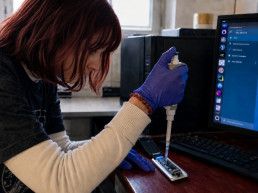
Preparing samples for metagenomic analysis (Photo: Eco2Wine project archive)
References
- Francesca, N., Gaglio, R., Alfonzo, A., Settanni, L., Corona, O., Mazzei, P., Romano, R., Piccolo, A., & Moschetti, G. (2016). The wine: Typicality or mere diversity? The effect of spontaneous fermentations and biotic factors on the characteristics of wine. Agriculture and Agricultural Science Procedia, 8, 769–773. doi: 10.1016/j.aaspro.2016.02.064
- du Toit, M.; Pretorius, I. S. (2000). Microbial spoilage and preservation of wine: Using weapons from nature’s own arsenal — A review. South African Journal of Enology and Viticulture, 21. doi: 10.21548/21-1-3559
- Stewart, E. J. (2012). Growing unculturable bacteria. Journal of Bacteriology, 194(16), 4151–4160. doi: 10.1128/JB.00345-12
- Morgan, H. H.; du Toit, M.; Setati, M. E. (2017). The grapevine and wine microbiome: Insights from high-throughput amplicon sequencing. Frontiers in Microbiology, 8, 820. doi: 10.3389/fmicb.2017.00820
- Zeman, M.; Böhmer, M.; Rusňáková, D.; Sedláčková, T.; Ženišová, K.; Pangallo, D.; Kuchta, T.; Budiš, J.; Szemes, T. (2023). Microbiome composition and dynamics while grapes turn to wine. BIO Web of Conferences, 68, 02034. doi: 10.1051/bioconf/20236802034
- Bokulich, N. A.; Thorngate, J. H.; Richardson, P. M.; Mills, D. A. (2014). Microbial biogeography of wine grapes is conditioned by cultivar, vintage, and climate. Proceedings of the National Academy of Sciences of the United States of America, 111(1), E139–E148. doi: 10.1073/pnas.1317377110
- Flörl, L.; Schönenberger, P.; Rienth, M.; Bokulich, N. A. (2026). Grape expectations: disentangling environmental drivers of microbiome establishment in winegrowing ecosystems. npj Biofilms and Microbiomes, 12. doi: 10.1038/s41522-026-00915-x
- Bokulich, N. A.; Collins, T. S.; Masarweh, C.; Allen, G.; Heymann, H.; Ebeler, S. E.; Mills, D. A. (2016). Associations among wine grape microbiome, metabolome, and fermentation behavior suggest microbial contribution to regional wine characteristics. mBio, 7(3), e00631-16. doi: 10.1128/mBio.00631-16
- Kioroglou, D.; Lleixà, J.; Mas, A.; Portillo, M. D. C. (2018). Massive sequencing: A new tool for the control of alcoholic fermentation in wine? Fermentation, 4(1), 7. doi: 10.3390/fermentation4010007
- Izquierdo-Bueno, I.; Moraga, J.; Cantoral, J. M.; Carbú, M.; Garrido, C.; González-Rodríguez, V. E. (2024). Smart viniculture: Applying artificial intelligence for improved winemaking and risk management. Applied Sciences, 14(22), 10277. doi: 10.3390/app142210277